SJS Safeguarding & Child Protection Policy
We believe all children have the right to be protected and safe from harm.
Contents
- Use of the Term "Our People"
- Policy Purpose & Brief
- Scope
- Our Commitment
- Revision
- Declaration
- Safeguarding and Child Protection Procedures
- Designated Person(s)
- Code of Conduct
- Keeping safe - Safeguarding - proactive prevention, Safety Checks and Police Vetting
- Responding to child protection concerns
- Confidentiality and Information Sharing
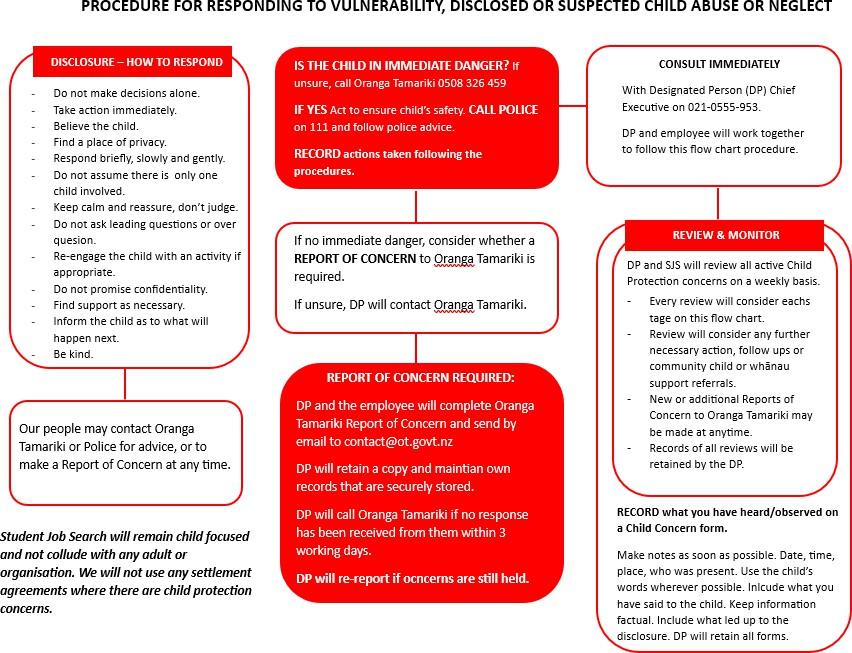
- Appendix 1: Procedure for Responding to Vulnerability, Disclosed or Suspected Child Abuse or Neglect
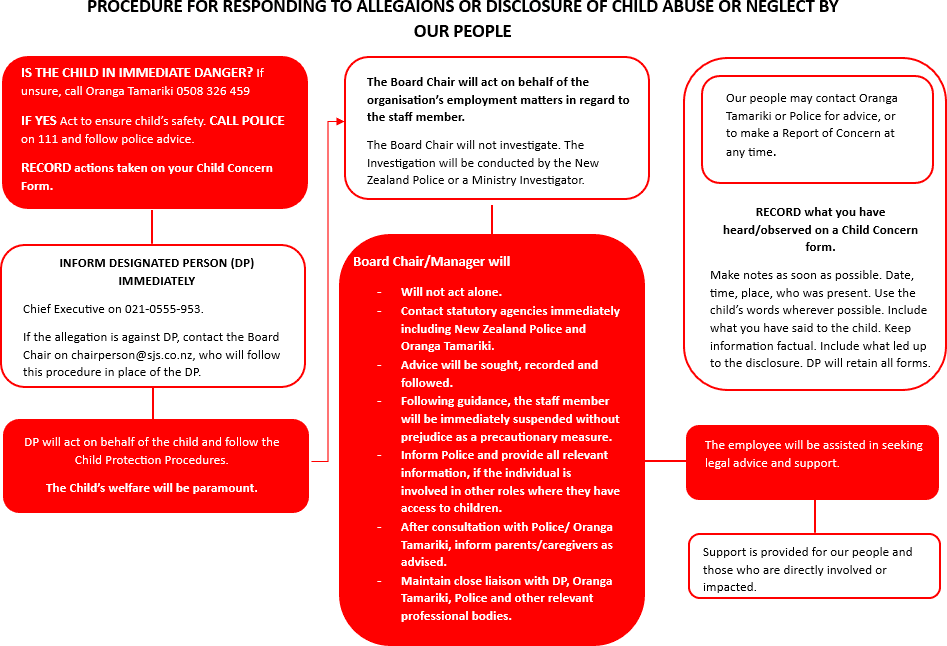
- Appendix 2: Procedure for Responding to Allegations or Disclosure of Child Abuse or Neglect by Our People
Use of the Term "Our People"
Throughout SJS policies, the term "Our People" refers collectively to employees, contractors, volunteers, and Board members. Where it is necessary to refer to a specific group or groups within this definition, an asterisk (*) will be used as an indicator. Where appropriate, the role will be explicitly detailed.
Policy Purpose & Brief
The Student Job Search (SJS) Safeguarding & Child Protection Policy and Procedure:
- Details our commitment to protecting children and young people in our care.
- Provides Our People with clear guidance on how to recognise and respond to suspected or confirmed cases of child abuse.
- Ensures reported concerns are referred to appropriate child protection agencies or authorities as required.
Scope
Our People will be aware of their responsibilities for safeguarding and promoting the welfare of children. As per the Act, our responsibilities apply to anyone under the age of 18. Therefore, this Safeguarding and Child Protection Policy applies to:
- Our People.
- Students on placement, visitors, contractors.
- The children we provide a service to and their families, caregivers, or guardians. For the purpose of this policy, the term child or children includes anyone under the age of 18.
- Employers who register to use our services.
We acknowledge that Oranga Tamariki and their contractors have extended age group requirements for their provision of services to specific groups of children up to the age of 25. While we are not required to plan for the protection of this group, we will ensure Our People are mindful that young adults can be vulnerable, and therefore we will apply our procedures to all young people up to the age of 25 as appropriate. We note Oranga Tamariki and their contractors are required to include the protection of children up to:
- 21, if they have been "in care" as per the Oranga Tamariki Act, the Criminal Procedure Act 2011, or the Corrections Act 2004.
- 25, if they are receiving transitional support under the Oranga Tamariki Act 1989.
Our Commitment
As a group, we at Student Job Search are committed to adopting a culture of safeguarding children by:
- Placing a child's rights, safety, and dignity at the forefront of our decisions and considering them in all aspects of our business.
- Helping to protect all children regardless of age, disability, gender, race, religious belief, sexual orientation, or identity.
- Assigning a competent Designated Person in every workplace.
- Ensuring our Code of Conduct is adhered to.
- Sharing information about concerns for children with agencies who need to know, and involving parents and children appropriately.
- Creating opportunities for Our People to be trusted points of contact and positive role models for children in our care.
- Ensuring our Safeguarding and Child Protection Procedures are:
- Up to date.
- Compliant with applicable, current legislation.
- Included in training.
- Shared with relevant people.
Disciplinary Processes
Any breach in Student Job Search's Position of Trust may be subject to disciplinary action up to and including dismissal. Any breaches of law, including conduct relating to abuse and neglect, will be referred to New Zealand Police.
Revision
This policy shall be reviewed every three years. A review may also take place following any serious incident to ensure the policy and its procedures are effective and make improvements where necessary.
Declaration
We are committed to ensuring a strong culture of safeguarding that consistently promotes the safety and well-being of children. We recognise the importance of having the Safeguarding Policy and Procedures in place, which serve to guide us in fulfilling our contractual obligations to our funder and to positively support Our People in such a way as to achieve this goal.
Safeguarding and Child Protection Procedures
Included in these procedures:
- Definitions
- Designated person
- Code of Conduct
- Keeping safe (safeguarding - proactive prevention)
- Responding to child protection concerns (child protection - reactive)
- Confidentiality and information sharing
Definitions
- Child Abuse and Neglect: The harming (physical, emotional, sexual), ill-treatment, abuse, neglect or deprivation of any child or young person. It includes actual, potential, and suspected abuse.
- Child Protection: The actions taken to ensure the safety of a child or young person in cases where there is abuse or neglect.
- Cumulative Harm: The effects of patterns of circumstances and events in a child or young person's life that diminish their sense of safety, stability, and wellbeing. Cumulative harm is compounded by multiple episodes of abuse or layers of neglect, and the constant daily impact can be profound and exponential across multiple dimensions of life.
- Emotional abuse: Any act or omission that results in impaired psychological, social, intellectual, or emotional functioning and development of a child or young person.
- Grooming: When someone builds a relationship, trust, and emotional connection with a child or young person so they can manipulate, exploit, and sexually abuse them.
- Neglect: Any act or omission that results in impaired physical or emotional functioning, injury or development of a child or young person. This can include physical neglect, neglectful supervision, emotional neglect, medical neglect, and educational neglect.
- Position of Trust: The relationship between a caregiver (adult, 18 years or older) or peer (for example, a youth leader) and their charges (child or young person) where they have, or are perceived to have, power, influence, or authority because of their role or duties assigned by an organisation. A Position of Trust is one of privilege, but that power and influence can lend itself to abuse in the wrong hands.
- Safeguarding: A preventative approach to child protection by minimising or eliminating harm to a child.
Designated Person(s)
Our Designated Person for Child Protection is:
Role: Chief Executive
Phone: 0800 757 562
Email: operations@sjs.co.nz
Please contact our Chief Executive with any issues relating to a child's safety, wellbeing or for guidance regarding our Safeguarding and Child Protection Policy and Procedures.
Designated Person's responsibilities
- Promote our commitment to a culture of safeguarding.
- Ensure the Safeguarding and Child Protection Policy and Procedures are readily available and understood by Our People.
- Ensure Our People have received regular applicable training as per these Procedures.
- Keep up to date with changes in legislation.
- Identify any barriers to implementation and compliance with these Policy and Procedures and remedy these.
- Communicate with Our People about any updates or changes.
- Provide ongoing advice and support to anyone who is concerned about a child or wants advice about the Safeguarding and Child Protection Policy and Procedures.
- Notify relevant agencies if a child is suffering from suspected or actual abuse or neglect.
Code of Conduct
The Code of Conduct sets standards and expectations for Our People when working with children, directly or indirectly. It guides the appropriate standards of behaviour expected.
You MUST
- Treat all children with respect.
- Set an example of ethical conduct by being a positive role model.
- Ensure that an unequal balance of power (a Position of Trust) is not used for any personal advantage, such as abuse or grooming, and maintain professional boundaries.
- Operate within the organisation's principles, procedures, and guidance provided in the Safeguarding and Child Protection Policy and Procedures.
- Respect a child's right to personal privacy.
- Encourage and support children and colleagues to report unacceptable attitudes or behaviour as soon as possible.
- Report all allegations, suspicions, or actual cases of abuse.
- Adopt open-door practices or work within sight or hearing of others, if possible.
- Always know the whereabouts of children in your care.
- Ensure visitors are always monitored.
- Advise parents or caregivers in advance of any activity that requires Our People to have physical contact with a child or children.
You MUST NOT
- Behave in any way that may be misinterpreted as poor practice, bullying, or potentially abusive behaviour towards children.
- Wherever possible, be in situations where you are alone with a child or children.
- Have inappropriate physical, verbal, phone, or social media contact with children.
- Make derogatory remarks in front of children.
- Dismiss or trivialise any child abuse issues raised.
- Show favouritism towards any individual.
- Take a chance when common sense, policy, or practice deems another appropriate approach.
- Take a child or children off-site without written consent from a parent or caregiver.
- Believe "It could never happen here".
Keeping safe - Safeguarding - proactive prevention, Safety Checks and Police Vetting
The Children's Act 2014 requires a safety check to be completed for all core children's workers at SJS. Safety checks are ongoing, and Our People required to undergo a safety check will then have these repeated at least every three years. Safety checks may also be required more frequently if:
- A position change results in an increase in children's contact or responsibilities.
- A concern is raised against an individual, which creates a need for re-assessment of their suitability for the role.
Safety check documentation will be filed with an individual's employment records as evidence of compliance with these policies and procedures. Please refer to our Recruitment Policy for more information about which roles are subject to New Zealand Police Vetting and which roles are subject to Ministry of Justice criminal checks.
Training
Training includes induction, supervision, and ongoing support. Our People* (not including our Board Members) will receive safeguarding and child protection training upon induction, followed by refresher training. The level of training will be appropriate to the role Our People have within Student Job Search and will:
- Understand expectations related to the Policy, Procedures and Code of Conduct.
- Be able to recognise safeguarding and child protection concerns.
- Effectively and confidently respond to, and report, concerns.
- Know how to maintain focus on a child's best interests when responding to suspected or confirmed abuse.
- Recognise the importance of family and their right to participate in decisions made about their child or children, unless this would result in an increased risk to them.
- Know how to promote a culture where Our People feel confident to challenge poor practice and raise issues of concern.
Responding to child protection concerns: Child protection - reactive
Identifying signs of both potential and actual child abuse and neglect:
- Physical signs: The child has unexplained injuries including broken bones, sprains, fractures, cuts, burns and poisoning. It seems likely the injuries were not accidental, such as unexplained head injuries. The parent cannot explain or recall when the injury happened.
- Behavioural signs: The child shows signs of distrust in adults, parents, or caregivers, or is excessively friendly and trusting of adults who are strangers. They may show excessive concern and fear when they hear other children crying, wear clothing that covers their body in hot weather, be passive and withdrawn, bully others, appear hyperactive, be unable to settle or concentrate, or engage in inappropriate play or conversation.
- Neglect: The child may show signs of malnourishment. They may steal or hoard food, wet the bed, have poor hygiene or unmet medical needs, wear inadequate or inappropriate clothing for the weather, use alcohol and drugs, have poor relationships with other children, be regularly absent from school, be aggressive, be alone for long periods without adult supervision, or run away from home or school.
- Emotional abuse: The child may have low self-esteem, high levels of anxiety, be aggressive or demanding, withdrawn or fearful, or behave in ways appropriate to children much younger than their actual age. Their speech or communication skills may be delayed. They may be fearful of the caregiver or excessively try to please the caregiver.
- Sexual abuse: The child may describe sexual activity, viewing pornography or engaging in prostitution. They may display sexual knowledge and sexualised behaviour not appropriate to their age. Related emotional distress can include stomach pains, difficulty sleeping, or difficulty relating to adults and other children of their own age.
Procedure for responding to vulnerability, disclosed or suspected abuse or neglect
In the event a child or young person discloses abuse, the steps below can be followed in Appendices 1 and 2.
Record keeping
Accurate and factual record-keeping is crucial for our records and communications with agencies such as Oranga Tamariki or the Police. Information to include in a Report of Concern to Oranga Tamariki or the Police, if known:
| Name of child | Name of GP if known | Provide details of questions you asked, and answers given. Use speech marks. |
| Date of birth, or approx. age | What are you concerned about? | Steps you have taken to safeguard the child |
| Address of child/whanau | What have you seen/heard? Give as much as possible | Who else is aware of your concerns or shares your concerns |
| Contact numbers | Who was present when you noticed something? | Have you spoken to the family about your concerns? If not, why? |
| Names of other children in household/whanau/group/team | If an injury, draw on body map, indicate left and right | Do the family know you are making the Report of Concern? If so, what was their response? |
| Names of parents/carers | When did it happen? | Pass on any information if you think making the Report of Concern will increase the risk to the child |
| Names of adults in household | What did the child say? | Your name |
| Names and details of the adult you are concerned about | What did the adult say/do that concerned you? | Your title/relationship to the child |
| School or groups attended | Is it a one-off incident or recurring? | Your contact numbers and organisation |
| Car registration if the child and adult are unknown to you | If injury, give explanation you were given about how it happened | If you want to be anonymous, please indicate on the Report of Concern. |
Confidentiality and Information Sharing
Under the Oranga Tamariki Act 1989, any person who believes that a child has been or is likely to be harmed physically, emotionally, or sexually or ill-treated, abused, neglected, or deprived may report the matter to a social worker or the Police. No civil, criminal, or disciplinary proceedings may be brought against the person who makes the report, provided it is made in good faith.
When gathering, storing, or disclosing personal information about individuals, workers must comply with the Information Privacy Principles set out in the Privacy Act 2020.
Sharing information with others for the protection of a child is a justifiable breach of confidentiality and, where a vulnerable child is at risk of harm, is a legal duty.
Appendix 1: Procedure for Responding to Vulnerability, Disclosed or Suspected Child Abuse or Neglect
Appendix 2: Procedure for Responding to Allegations or Disclosure of Child Abuse or Neglect by Our People